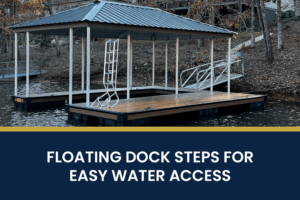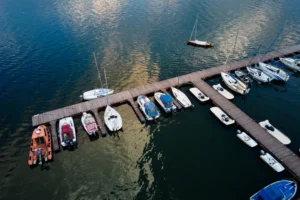

Stationary docks can be an excellent solution for waterfront properties with consistent water levels, as they’re great for accommodating high boat traffic while helping avoid issues caused by dramatic tide fluctuations. Building a dock requires various tools, including hammers, saws, saw blades, drills, measuring tapes, and levels. Furthermore, proper safety practices must always be observed when operating power tools.
Benefits of Stationary Docks
Stationary docks offer numerous advantages, especially for waterfront properties with stable water levels. One key benefit is their durability, as they are constructed with sturdy materials like pressure-treated wood, which ensures longevity and resistance to environmental elements.
Unlike floating docks, stationary docks provide a stable platform unaffected by changing water levels, making them ideal for areas with consistent water conditions. In boat dock building, stationary docks are often preferred for their robust structure, which can support heavy loads and withstand high boat traffic.
They serve as a reliable solution for docking boats, offering a safe and secure platform for boarding and unloading. Additionally, stationary docks can be customized to complement the aesthetic of any waterfront property, enhancing its overall value. When comparing fixed and floating docks, stationary docks are a superior choice for those seeking a permanent solution.
Pilings for Long Lasting Dock Build
A stationary dock rests on a permanent foundation that lies sunk below the water’s surface, with pilings long and strong enough to support its weight. Helical piles provide an alternative to traditional wooden pilings that must be driven into the ground at an identical depth regardless of soil conditions. They use the earth’s natural elasticity to drive themselves deep into the water and save you valuable time during construction phases.
- Select durable wood or concrete materials like corrosion-resistant treatment to resist damage from elements and wildlife.
- Measure water depth for determining dock height.
- Drill holes under the framework for each piling to cut it to length.
- Mix concrete mixture in each hole to prevent shifts over time.
- Mix/pour concrete around each one for lasting support posts and post anchorage.
The composition of the bottom can also play a factor in selecting an ideal dock style; for instance, areas with soft soil or steep drop-offs that contain loose rocks may not support fixed docks without shifting unnecessarily; should this be the case, consider building a permanent pier instead.
Footers for a Strong Foundation Under the Dock
Stationary dock footers anchor posts or pilings securely into the bottom of a lake or pond, providing stability that helps avoid shifting and is more durable than floating docks. They also help prevent rot from developing over time and are easy to repair should storm damage occur.
- Once the footers have been installed, you can start building your dock’s frame using pressure-treated lumber for maximum water resistance.
- Using a PVC pipe filled with concrete to surround the post makes the best footer.
- Choose cedar, composite decking, or a superior decking material as a surface for your dock.
- Cedar provides durability, while composite provides ease of maintenance.
- Hardwood provides luxury and longevity.
- Once the blocks have been laid out and placed in their appropriate spots, you must determine where to place the support posts.
Select an area above the highest watermark in your body of water to provide maximum stability and long-term support for your dock. Once done, use a post-hole digger or hire professional services to drill 8-foot-apart holes into the lake bed for pilings; use a level to ensure each post stands up vertically. Consider using light-colored decking materials for your dock’s surface to enhance durability and maintain a cooler temperature under the sun.
Choose a Reliable Decking Material
Stationary docks are an ideal solution for bodies of water with relatively stable levels, such as lakes and rivers. They allow boating with greater ease while offering spectacular views. Before building one, however, consideration must be given to site-specific needs such as lake bottom composition, stability issues, or anything that might influence how stable or safe the floating dock will be.
Foundational support is critical when building a stationary dock. Concrete blocks sunk into lake or river beds serve as anchor points that connect directly to chain shackles on either end of the dock structure; additionally, we recommend placing wooden or cardboard blocks underneath each anchor block to prevent damage to your floating dock decking from moisture intrusion.
Floaters for Floating Dock Options
If you’re considering upgrading or replacing a stationary dock with something more suitable, floating docks could be the ideal solution. They adjust to water levels for easier boat entry/exit and customizable features to give them an eye-catching appearance along the waterfront.
- Anchoring a floating dock is essential in waters with shifting depth or where boater traffic is high, as its foundation lies solely with the water.
- Installing a floating dock requires hiring a contractor to dig holes for mounting piles – which may prove costly and time-consuming if the water depth is large.
- Floats can be constructed from wood, aluminum, or concrete and come in various finishes and sizes.
Foam-filled floats are especially suitable as they’re stronger, more durable, won’t leach chemicals and won’t move around on the board surface during wear and tear. Once on support boards according to the diagram and securely fastened with marine-grade hardware, ensure they’re evenly spaced to provide adequate buoyancy and safety.
Anchors for Strong Dock Standing
As tempting as standing on an idyllic waterfront dock with legs dangling in the water and nothing but wind and sunshine overhead, floating freely is impossible without being secured to either ground or lakebed anchored docks.
- Anchoring your stationary dock can be done in many ways, with cable anchors being one of the most reliable methods.
- They connect to weights or the shoreline via a chain, making them easily adaptable to changing weather or seasons.
- Another great solution is pole and sleeve anchor systems of stiff vertical sleeves connected with long galvanized steel poles that connect them directly to your dock.
- These systems are easily set up quickly and work great in areas with strong winds or wave loads.
If your property experiences frequent waves or fluctuating water levels, stationary piers might be the ideal solution. They’re attached to pilings driven deep into the earth and can support heavy loads without breaking or sinking.
Conclusion
Building a stationary dock is a solid choice for waterfront properties with stable water levels, offering a durable, long-lasting solution for boat docking and recreational activities. Considering the site-specific conditions and using a quality dock, decking materials will enhance your waterfront property and be a functional and enjoyable addition for years.
Building a Durable Stationary Dock
Ready to transform your waterfront property with reliable, long-lasting dock repair? At Foothills Docks, we craft high-quality stationary docks. Our expert team ensures your dock is built to withstand the elements while providing a safe, secure platform for boating and waterfront activities. We are experts in dock construction, installation, fabrication, and manufacturing on upstate lakes. Contact us today to start planning your custom dock, and let’s create the perfect spot for you to enjoy the water for years to come!